The short answer
Use plywood where strength, screw-holding or moisture matter: beds, kitchen carcasses, sink units, long shelves and anything that carries weight. Use MDF where a perfectly smooth, flat face matters: painted doors, wall panels, carved or routed shapes and laminated cabinet fronts in dry rooms.
Many good builds use both: a plywood or HDHMR structure with MDF or laminate faces. The mistake is using ordinary MDF where water will reach it, or using cheap plywood where a smooth painted finish is needed.
What each board is made of
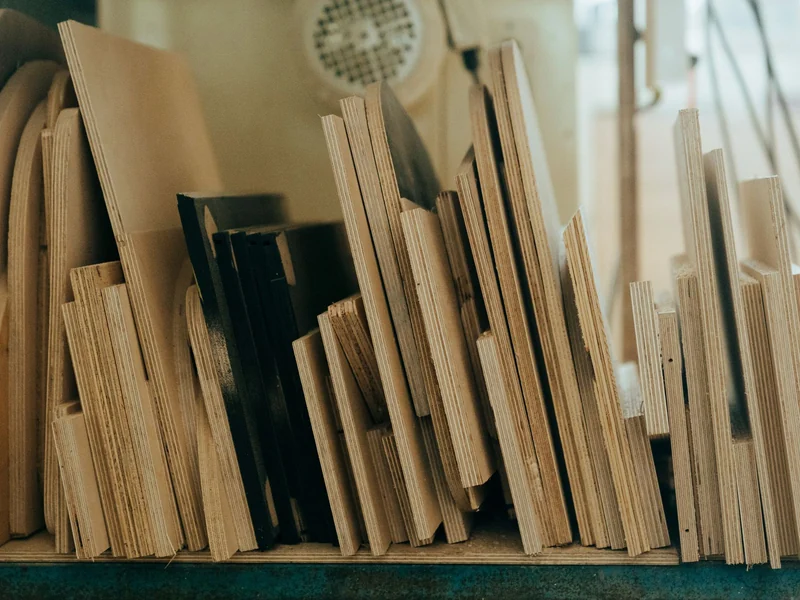
Plywood is thin layers of wood veneer glued together with the grain of each layer at right angles to the one below. MDF, short for medium density fibreboard, is fine wood fibre mixed with resin and pressed into a uniform sheet with no grain at all.
That difference explains almost everything else. The crossed layers make plywood strong along its length and across its width and let screws bite firmly. The uniform fibre makes MDF flat, easy to shape and perfect for paint, but weak at the edges and vulnerable to water.
Side-by-side comparison
The table lines up the points that decide most jobs.
| MDF | Plywood | |
|---|---|---|
| Strength | Medium, brittle at edges | High, stays strong along edges |
| Screw holding | Fair, weak near edges | Very good, even near edges |
| Moisture | Poor unless MR grade | Good with BWR or marine grade |
| Surface | Perfectly smooth | Needs veneer or laminate for a smooth finish |
| Weight | Heavy | Lighter for the same strength |
| Shaping and routing | Excellent, clean edges | Layers can chip |
| Cost level | Lower | Higher, rises with grade |
For the whole range of furniture boards, see our furniture board guide.
Moisture and humidity
This is where the two boards separate most. Ordinary MDF swells and crumbles when water reaches the core, so it should never be used near a sink, in a bathroom or on a floor that can flood. A moisture-resistant MDF grade helps, and a denser board such as HDHMR does much better, but both still need sealed edges.
Plywood handles damp air well, and BWR or marine grades are built for kitchens and bathrooms. Check the grade and the glue type, because a cheap commercial sheet is not waterproof just because it is plywood.
Strength, weight and screws
Plywood is the better structural board. It holds screws at the edge, resists splitting, and spans longer distances without sagging. That is why beds, kitchen carcasses and heavy shelves are better in plywood. MDF is fine for light-duty cabinets and doors, but long shelves in MDF sag under books, and screws pulled out of an MDF edge do not hold the second time.
If you must use MDF for a long shelf, use 25 mm board or add a support rail, and use proper cam fittings and dowels instead of repeated screws.

Finish: paint, laminate and veneer
MDF gives the smoothest painted surface because it has no grain to show through. It is the board of choice for sprayed doors and routed panels. Plywood needs a veneer or a laminate to hide its layers, and its edges either need banding or are left as a design feature.
Both boards take HPL and melamine well. See our MDF and HPL sheets section for the boards and laminates that go with each.
Cost: what you really pay
MDF is usually the cheaper sheet. Plywood costs more, and the rate rises with grade and thickness. The true cost of a job also depends on how many sheets you need, how well the board survives and whether you have to replace it. A cheaper MDF kitchen that swells in three years costs more than a plywood one that lasts twenty.
Published ranges on our site give a feel for the market, for example the MDF figures in MDF board uses and price and the cost of 1 MDF board. For plywood, we give written rates on the day because grades differ widely; see the plywood sheets guide.
Which to use in each room
Match the board to the room first, then to the budget.
| Where | Best choice | Why |
|---|---|---|
| Kitchen carcass | BWR plywood or HDHMR | Moisture and weight |
| Bathroom vanity | Marine plywood, HDHMR or PVC board | Steam and splashes |
| Wardrobe in a dry room | MDF or HDHMR with laminate | Economical and flat |
| Bed frame | Plywood | Strength and screw-holding |
| Painted doors and panels | MDF | Smooth, flat face |
| Long shelves | Plywood or thick MDF with support | Resists sagging |
Common mistakes to avoid
- Using ordinary MDF in a kitchen or bathroom: it swells when water reaches an exposed edge.
- Buying plywood without asking the grade: commercial, BWR and marine differ in glue and price.
- Skipping edge sealing: every cut edge of either board needs sealing or banding.
- Trusting the thickness label: measure with a caliper before you accept the sheet.
- Overloading long spans: support shelves instead of relying on thickness alone.
MDF vs Plywood: Frequently Asked Questions
For strength, screw-holding and moisture, usually yes. For a smooth painted surface and shaped panels, MDF is better. Neither is best everywhere, so match the board to the job: plywood for structure and wet areas, MDF for painted or laminated faces in dry rooms.
Only in a moisture-resistant grade with every edge and cut-out sealed, and kept away from the sink. For kitchen carcasses, HDHMR or BWR plywood is safer because ordinary MDF swells and crumbles when water reaches the core, even through a small gap.
MDF is usually the cheaper sheet, and plywood costs more, with the rate rising for BWR and marine grades. The better question is cost over time: a board that swells or sags in a few years is more expensive than one that lasts.
In dry rooms, MDF or HDHMR with a laminate face is economical and flat. For long spans, heavy loads or wardrobes on damp outer walls, use plywood or HDHMR instead. Add support rails to long shelves in any board, and seal every cut edge.
Plywood holds screws much better, especially near the edge, because the crossed layers grip the thread. MDF holds screws fairly in the face but weakly at the edge, and a screw removed from MDF rarely holds as well the second time.
Send the board type, thickness, size and quantity on WhatsApp. We reply with a written rate per sheet that is current on that day, and we can recommend the right board if you tell us the room and the piece you are building.