Skirting Tiles: Sizes, Heights, Designs and How to Fit Them
Skirting tiles are the strip of tile that runs along the bottom of a wall where it meets the floor, protecting the wall from mops, furniture and splashes while hiding the uneven edge of the floor. This guide covers tile skirting and skirting boards together: the sizes and heights people use, the colours that work, a simple calculator example and how the strip is fitted. It is part of our wall moulding hub, because skirting is the moulding at the base of the wall.
Tile skirting or a skirting board?
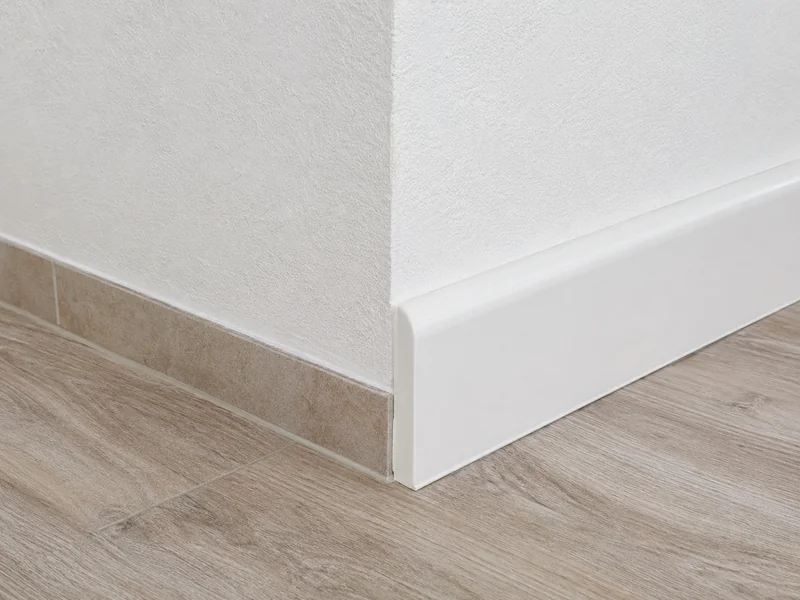
Floor tile covers the room, and the skirting strip turns the same material up the wall for a few inches. It is usually cut from the floor tile, or bought as a ready-made strip with a finished top edge. A skirting board is the same idea in a different form: a moulded strip of PVC, MDF or wood fixed to the wall.
Tile skirting is easy to clean and matches the floor. A board gives a slightly more finished shadow line and can cover wall unevenness. In wet areas, tile or PVC is the safer choice; in dry bedrooms and lounges, MDF and wood boards are common.
Colours and finishes that work
Start from the floor. A strip that follows the floor colour makes the room feel taller and cleaner; one that contrasts makes a deliberate border.
White and light colours
White is the safest choice. It goes with almost any floor and wall colour and brightens the base of the wall in rooms with little daylight.
Black and grey
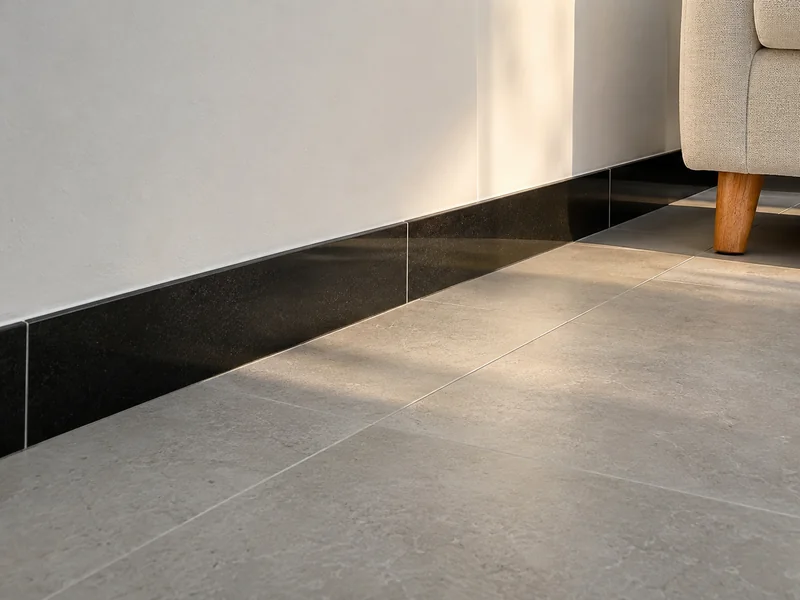
A black strip gives a sharp, modern line against a white or light grey floor, best on plain walls and kept low in small rooms. Grey hides scuff marks better than white, so it is popular in lounges, offices and corridors.
Marble, porcelain and ceramic
Marble suits formal lounges and entrances. Porcelain is dense and low-absorption, so it handles wet areas well. Ceramic is the usual budget choice for bedrooms and corridors. A small glazed metro-style tile in a row suits bathrooms and kitchens.
Matching the floor
Line the strip up with the floor grout lines so the two read as one. A slim strip with a bullnose top gives a soft edge, a taller strip suits a drawing room, and a contrasting strip works as a border in a feature room.
Standard sizes and heights
There is no single rule, but common practice is a strip roughly 4 to 6 inches (about 100 to 150 mm) high. That is the usual size in homes: high enough to protect the wall, low enough to look tidy. Drawing rooms often go taller, towards 6 to 8 inches, to give the base of the wall a formal finish.
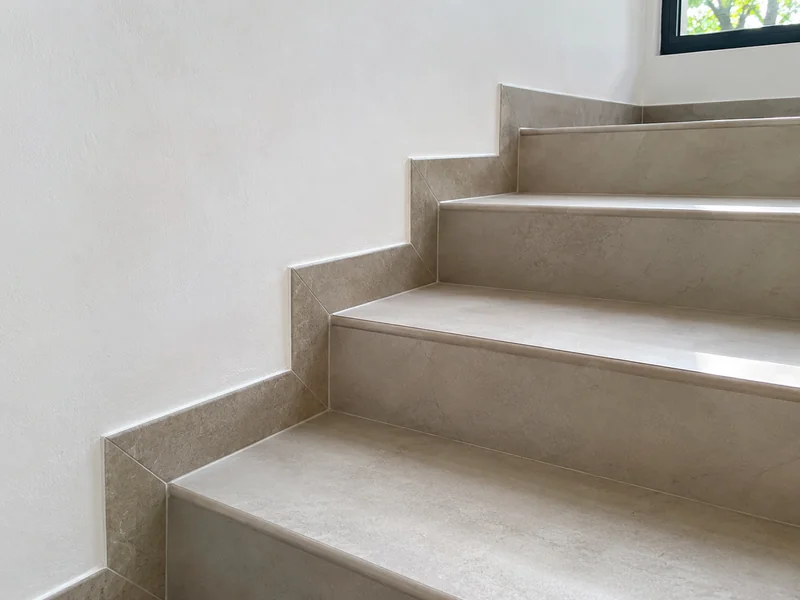
Most people cut a floor tile into strips. A 2 ft long floor tile cut into 4 inch strips gives six strips per tile, which is why cutting from the floor tile is economical. Keep the height identical all the way round the room, including around door frames, and finish the top edge with a profile or bullnose so it looks intentional.
Skirting meets the floor, so check our flooring range if you are choosing the floor and the strip together.
If you want a framed wall above the skirting, the same layout logic applies as in French wall moulding; for lightweight trims, see PVC moulding. Send a photo of your floor tile and the room size on WhatsApp for matching options.
Frequently Asked Questions
Add up the room perimeter, subtract door widths, divide by the strip length and add about 10% for cuts. For example, 49 ft of wall with 2 ft strips needs 25 pieces, or 28 with cuts. Measure your own room and round up.
Lay the floor first, cut strips to equal height, fix them with tile adhesive keeping the top edge level, then grout the strip joints. Leave a small gap at the floor line and seal it with flexible sealant for a neat finish.
Use flexible sealant, not hard grout, along the line where the strip meets the floor, and keep it continuous at corners and doorways. In wet rooms, apply a waterproofing coat to the wall base before fixing the strip, and let it cure fully.
Strips around 4 to 6 inches high are the common choice, and drawing rooms often go a little taller. Keep the height the same around the whole room, including door frames and built-in cupboards, so the line looks deliberate and tidy.
White suits almost every room, grey hides scuffs, and black gives a sharp contrast on a light floor. Match the strip to the floor for a taller-looking room, or contrast it on purpose for a border. Always check a sample next to your floor in daylight.
Moulding is priced per sq ft of wall: French moulding PKR 300 – 550, framed French wall PKR 400 – 600 (PKR 500 – 750 painted) and moon wall PKR 800 – 1,000.
Yes, we can quote tile skirting and PVC or MDF skirting boards, with installation in Lahore and supply across Pakistan. Tell us the room, the floor and the look you want on WhatsApp, with a photo if possible, and we will reply with the options available.
Need skirting for your floor?
Send a photo of the floor tile and the room size. We will quote tile or board skirting and fitting.