Acoustic Foam Panels: Types, Thickness, Uses and What They Cannot Do
Acoustic foam panels are the lightest and most affordable way to cut echo in a small room, which is why they are common in podcast rooms, studios, gaming rooms and home cinemas. They absorb mid and high frequencies well, but they do not block sound passing through a wall and they do little for deep bass. This guide explains the shapes, the thickness choices, where foam is the right answer and where it is not, how to fix it and what to check on fire safety. Rates are on our acoustic panels price page.
What acoustic foam does
Open-cell foam traps sound energy in its pores and turns it into a tiny amount of heat, which shortens the echo inside a room. It improves speech clarity and recording quality, and makes a bare room feel less harsh. It is an absorber, so it treats the sound inside a room and not the sound that escapes it.
Wedge, pyramid and flat foam
Surface shape changes the look and the feel, and thickness changes the performance.
| Type | Look | Best for | Note |
|---|---|---|---|
| Wedge | Angled ridges | Studios, podcast and gaming rooms | Most common shape |
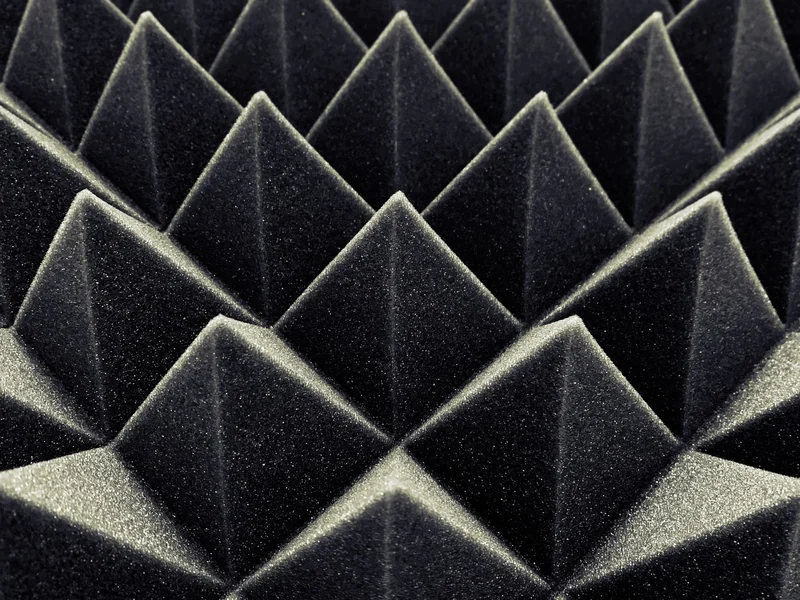
| Pyramid | Pointed cones | Vocal booths, small cinemas | Good absorption for the size |
| Flat tile | Smooth, plain | Offices, meeting rooms | Neater, less studio look |
| Corner foam | Thick wedge block | Room corners | Helps with low-frequency build-up |
Our published range for foam is on the acoustic panels page.
Thickness: 25, 50 or 75 mm
We supply 25, 50 and 75 mm foam. Thin foam handles high frequencies and light echo, which suits speech and small rooms. Thicker foam absorbs further down the range and suits cinemas and music rooms. Foam alone rarely controls true bass, so a studio with a bass problem needs deeper treatment in the corners.
Where foam is the right answer
- Podcast and voiceover rooms: cuts echo around the microphone.
- Gaming and streaming rooms: cleaner voice and less room sound.
- Home cinemas: controls reflections, usually with fabric panels as well.
- Practice and music rooms: tames flutter echo on parallel walls.
For homes, offices and lounges where looks matter, consider decorative acoustic panels instead.
What foam cannot do
Foam does not soundproof. Putting it on a wall will not stop a neighbour's noise or keep your noise in, because blocking sound needs mass, sealing and separation. Our guide do soundproof wall panels work explains the difference. Foam also looks utilitarian, and low-density foam can crumble and fade in strong sun.

Fire safety and quality checks
Cheap foam can burn fast. Ask for the fire rating of the foam before you buy, especially for rooms with public access, and keep it away from heaters and lamps. Check the density, since light foam wears sooner, and ask for the thickness in writing.
How foam is fixed
Foam is usually fixed with spray adhesive or double-sided tape, and corner blocks are glued into the corners. Adhesive can mark paint when removed, so use removable mounting if you rent. Clean the wall first, start at the top and press firmly so edges lie flat.
How we quote
Send the room size, the use and the wall you want to treat. We confirm the right shape and thickness and reply with a written rate.
| Item | Unit | Material only or installed | Supply area | Rate |
|---|---|---|---|---|
| Acoustic foam panels, by shape and thickness | Per sq ft | Material only | Supply across Pakistan | PKR 250 – 380 |
Acoustic Foam Panels: Frequently Asked Questions
No. Foam absorbs sound inside the room to reduce echo, but it does not stop sound passing through walls, doors or windows. Blocking noise needs mass, sealed gaps and separation between surfaces. Use foam for echo control, and add proper soundproofing if noise leaks in or out.
Thin 25 mm foam suits speech and light echo, 50 mm is a good general choice, and 75 mm absorbs lower frequencies for cinemas and music rooms. Foam alone does not control deep bass, so a studio with a bass problem also needs deeper corner treatment.
A common starting point is about 15 to 30 per cent of the wall area, placed at the reflection points and the rear wall. Check how the room sounds after the first panels and add more if it still echoes. Covering every wall can make a room sound dead.
It can be, because low-quality foam burns quickly. Ask the supplier for the fire rating, keep foam away from heaters, lamps and open flames, and choose a rated product for rooms used by the public. Never assume that all foam has the same safety standard.
Good dense foam lasts for years indoors, but low-density foam can crumble, sag and fade in strong sun or heat. Keep it away from direct sunlight, dust it gently and avoid wetting it. Replace tiles that lose their shape or start to flake.
Send the room size, how you use the room and a photo on WhatsApp. We recommend the shape and thickness, tell you how much coverage to plan and reply with a written rate that states the thickness and fitting so you can compare it with other quotes.
More Acoustic Panels Pages
Treating a studio or cinema room?
Send the room size and a photo. We reply with a written rate.